The Real Price of a Click on Amazon
Amazon advertising revenue reached $68.63 billion in 2025, and advertising revenue grew 12% year-over-year in Q3 2026, with Amazon expecting high-teens growth in Q4. Every dollar of that revenue comes from sellers and brands bidding on clicks. The median blended CPC across all campaign types was $1.07 in H1 2026, with the middle 50% of accounts paying between $0.75 and $1.85 per click. Knowing the average Amazon PPC cost is table stakes. Knowing what you can afford to pay per click, given your margins, your category and your growth stage, is what separates profitable campaigns from expensive vanity metrics.

What Drives the Cost of an Amazon Click?
Amazon PPC runs on a second-price auction. You set a maximum bid, but you pay just enough to beat the next-highest bidder. That sounds simple, but the final CPC you see on your dashboard is shaped by five variables working at the same time.
Category competition
Category is the single biggest cost lever. Health and Wellness runs the highest CPC at around $2.89 with ROAS near 2.5x. Beauty jumped from $1.85 to $2.47 average CPC year over year, while Books sits as low as $0.45. That spread means the "average" CPC is almost meaningless for planning. A supplements seller and a books seller live in different economic realities.
Ad format
Sponsored Products remain the highest-volume and most efficient format, with average CPC between $0.75 and $1.50. Sponsored Display is where the real cost shock is: CPCs rose 49% year-over-year to approximately $3.72 average, according to Ad Badger's 2026 benchmarks. Sponsored Brands fall in between, typically running $1.10 to $2.50.
Keyword specificity
Long-tail keywords average $0.64 CPC compared to $1.18 for broad terms. The difference is not small. A keyword like "protein powder" might cost $2.30 per click, while "grass-fed whey protein isolate chocolate 5lb" could cost $0.65, roughly 3.5x cheaper. Long-tail shoppers also convert at higher rates because they already know what they want.
Placement and match type
Top-of-search placement costs $1.63 per click on average, while product detail page placements run $1.21 and other on-Amazon placements $1.12. Exact-match clicks cost $1.59 compared to $1.36 for broad, but exact converted at 22.8% versus 11.5%. Paying more per click for a placement or match type that converts at double the rate can still be the smarter bid.
Seasonality
Median CPC climbed from $0.99 in January to $1.36 in June, a 37% increase in six months, driven by the Prime Day ramp-up. Prime Day and the Q4 holiday season routinely push average costs to $1.35 to $1.45, a 60 to 80% jump from baseline. Build seasonal CPC inflation into your budget or you will run dry at the worst possible moment.
How Budgets Differ by Category and Stage
Two products at the same price point can need radically different ad budgets depending on their category CPC and their lifecycle stage. Here is a practical breakdown.
By category tier
- High-CPC categories ($1.50 to $3.00+): supplements, beauty, electronics. Deep-pocketed brands, high order values, and repeat-purchase economics justify bids well above what a single click returns. Monthly ad spend for a single product cluster often starts at $3,000 to $5,000.
- Mid-CPC categories ($0.75 to $1.50): home and kitchen, pet supplies, sports and outdoors. Enough advertisers to make clicks expensive, but not enough to make them punishing. $1,500 to $3,000 per month is a common range.
- Low-CPC categories (under $0.75): books, grocery, office products. Clicks are cheap, but margins per unit are often thin. $500 to $1,500 per month can generate meaningful data.
By lifecycle stage
- Launch (months 1 to 3): New products need aggressive advertising to build sales velocity and organic ranking. Expect 35 to 50% ACoS during this window. You are buying ranking position, not immediate profit. Plan on $50 to $100 per day minimum for meaningful launch velocity. Our product launch playbook covers the week-by-week detail.
- Growth (months 4 to 12): organic sales should be building. Target ACoS drops toward break-even. Budget shifts from broad discovery to exact-match campaigns on proven keywords.
- Maturity: the goal is efficiency. Mature campaigns often run an ACoS between 20% and 35%. Ad spend as a share of revenue (TACoS) should trend down, with a median around 15% for established accounts.
If you are unclear on what "good" ACoS looks like for your specific product, read our guide to calculating target ACoS.
Setting a Starting Budget from Scratch
You do not need a spreadsheet with 40 tabs. You need three numbers: your expected CPC, your target daily clicks, and your conversion rate. From those, you can back into a budget that buys enough data to make decisions.
- Estimate your category CPC: check the SellerPlex H1 2026 benchmark report or pull suggested bids from Amazon Campaign Manager for your top 10 keywords. Average them.
- Decide how many clicks you need per day: at a 10% conversion rate, 100 clicks produce about 10 orders. If you need five orders a day to build velocity, aim for 50 clicks.
- Multiply clicks by CPC: if your keyword CPCs average $1.00 and you want 20 clicks per day, set a $20 budget for that campaign. Across two to three campaigns, that puts you at $40 to $60 per day total.
- Set a 14 to 30 day commitment: commit to at least 14 to 30 days before judging profitability, unless spend is obviously wasteful. Early data is noisy. Give the campaigns time to accumulate conversion signal before making structural changes.
Amazon's own Sponsored Products best practices guide recommends starting with a daily budget of $10 per campaign, a starting point small enough that a mistake does not cost you much while you learn how your specific product performs. That is fine for a single campaign. If you are running three campaigns (auto, manual broad, manual exact), plan for $30 to $50 per day as a practical floor.
For sellers who want to lower ACoS step by step, getting the starting budget right is half the battle. Overspending on discovery without a system to harvest winners wastes money. Underspending means you never collect enough data to optimize.
How to Calculate Your Maximum CPC from Your Margins
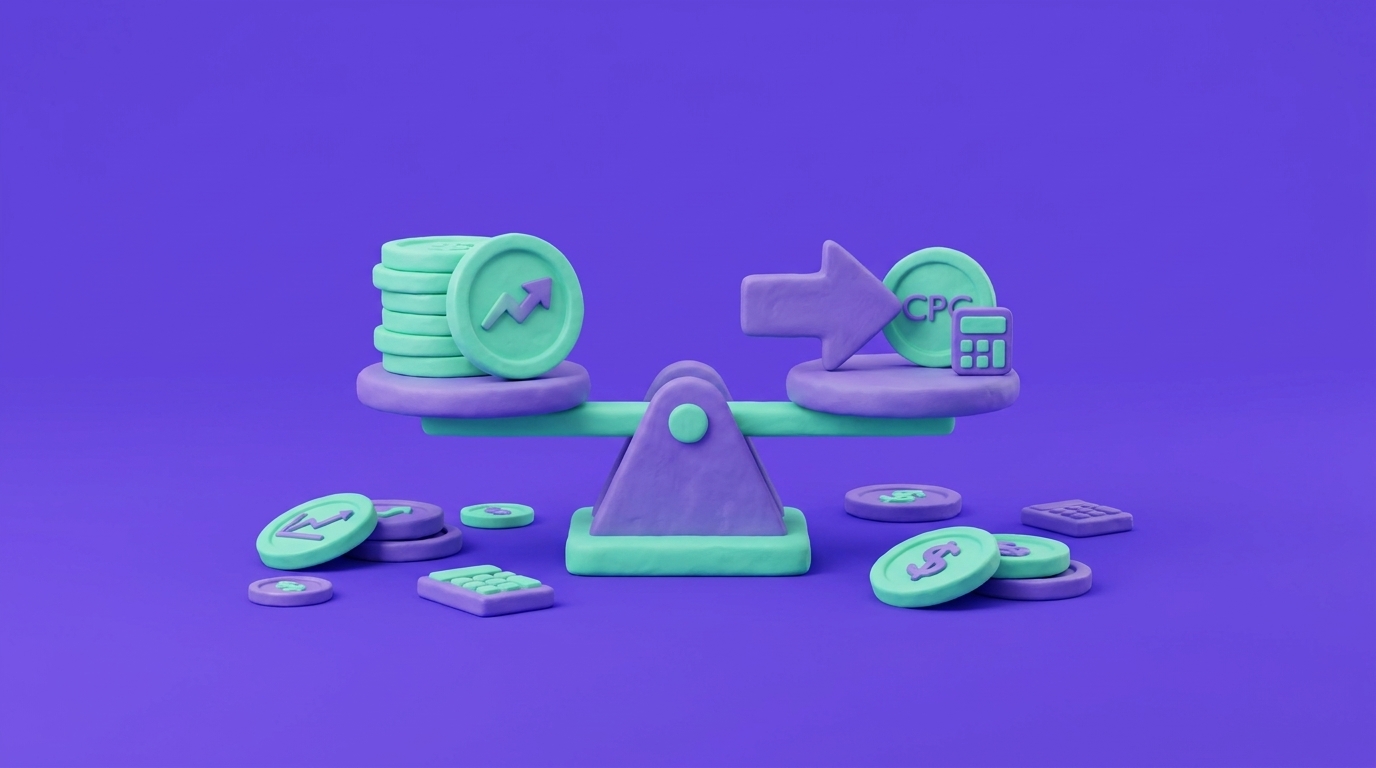
The most important number in your ad account is the most you can afford to pay per click and still make money. Here is the formula:
Max CPC = Pre-ad profit per unit x Conversion rate
Your maximum profitable CPC is profit per unit multiplied by conversion rate. Any bid above this loses money on every converting click, regardless of keyword quality.
This works because every converting click "carries" the cost of all the non-converting clicks around it. If your conversion rate is 10%, one out of every ten clicks turns into a sale. Your profit on that one sale has to cover the cost of all ten clicks.
Worked example (illustrative, round numbers)
These numbers are simplified to show the logic. Your real figures will differ.
- Selling price: $30.00
- Amazon referral fee (15%): $4.50
- FBA fulfilment fee: $5.50
- Cost of goods (landed): $8.00
- Pre-ad profit per unit: $12.00
- Conversion rate: 10%
- Max CPC: $12.00 x 0.10 = $1.20
At $1.20 per click you break even on ad-attributed sales. Every click below $1.20 is profit, every click above it is a loss. If you want to keep a 25% margin on ad-driven sales, reduce your target CPC to $0.90 (75% of the max). That gives you $3.00 in profit per ad-attributed sale after covering the cost of all ten clicks.
The same formula works in reverse to stress-test a bid. If Amazon's suggested bid for your top keyword is $1.80 and your max CPC is $1.20, you either need to improve your conversion rate (which raises the max CPC) or find cheaper long-tail keywords. Bidding $1.80 because the campaign manager told you to is how brands burn through budget and blame PPC for being "too expensive."
For a deeper look at how to judge ad spend by profit, see our overview of Amazon PPC profitability.
What Moves the Needle After You Launch?
Once your campaigns are live, CPC is only one of three levers. The other two are conversion rate and listing quality, and they interact.
Amazon's algorithm uses predicted conversion rate to determine auction winners and effective cost. High-quality listings with complete attributes, optimized titles, and A+ content are predicted to convert better, so they receive better impression share for lower effective CPC, even at the same nominal bid. Two sellers bidding $1.20 on the same keyword can pay different actual CPCs if one listing converts at 15% and the other at 8%.
That means conversion rate optimization is a PPC cost lever. Better images, tighter bullet points, more reviews: all of these push your effective CPC down without touching your bids. It is the closest thing to a free lunch in Amazon advertising.
Historical benchmark data shows average CPC at around $0.71 before 2020, rising to approximately $0.97 in 2023 and $1.22 in 2026. CPCs have roughly doubled in six years and show no sign of flattening. The sellers who maintain profitability through that inflation are the ones who treat listing conversion rate as a cost-reduction tool, not a separate project.
Where the Money Actually Goes
A common mistake is looking at total ad spend and panicking. The better metric is TACoS: total advertising cost of sales, which measures ad spend against all revenue, organic and paid. Median TACoS sits at 15% in the SellerPlex dataset, with the middle half of accounts between 10% and 21%. If your organic sales are growing while TACoS holds steady or drops, your ads are working as a flywheel even if campaign-level ACoS looks aggressive.
In SellerStack's mid-2026 data, pooled CPC went from $1.11 to $1.36 while conversion held near 16%, and pooled ACoS climbed from 21.3% to 27.6%. CPC inflation hits your ACoS directly unless conversion rate rises to compensate. That is why margin math and CPC math are inseparable: you cannot plan one without the other.
Your max CPC is a number you calculate from your own P&L, and every bid decision should sit below it. If you want help running that math across your full catalog and building campaigns around it, request a free Amazon audit and we will benchmark your account against current category data.
Hyperzon builds PPC strategies around your real unit economics, not platform averages. If your campaigns are spending without a clear max CPC, you are guessing with margin dollars. Get a free Amazon audit.
Article was originally published on 01 November, 2026
Frequently Asked Questions
-
What is the average Amazon PPC cost per click?
The platform-wide average CPC across all ad formats sits around $1.07 to $1.22 in 2026, depending on the data source. Sponsored Products run $0.75 to $1.50, Sponsored Brands $1.10 to $2.50, and Sponsored Display around $3.72. -
How much should I budget per day for Amazon PPC?
Amazon recommends a starting daily budget of $10 per campaign. Most sellers running a single product across two to three campaigns spend $30 to $75 per day. Competitive launches in high-CPC categories often need $100 to $200 per day. -
How do I calculate the most I can afford to pay per click?
Multiply your pre-ad profit per unit by your conversion rate. For example, if your profit before ad spend is $10 and your conversion rate is 10%, your maximum CPC is $1.00. Bidding above that number loses money on every converting click. -
Why is my Amazon CPC higher than the average?
CPC varies by category, keyword competitiveness, match type, ad format, and placement. Top-of-search placements average $1.63, supplements can exceed $2.50, and broad keywords cost more per conversion than long-tail terms. -
Do Amazon PPC costs change during the year?
Yes. CPCs rise around Prime Day and Q4 holidays, often 30 to 60% above baseline. SellerPlex data showed median CPC climbing from $0.99 in January to $1.36 in June 2026, largely driven by the Prime Day run-up.