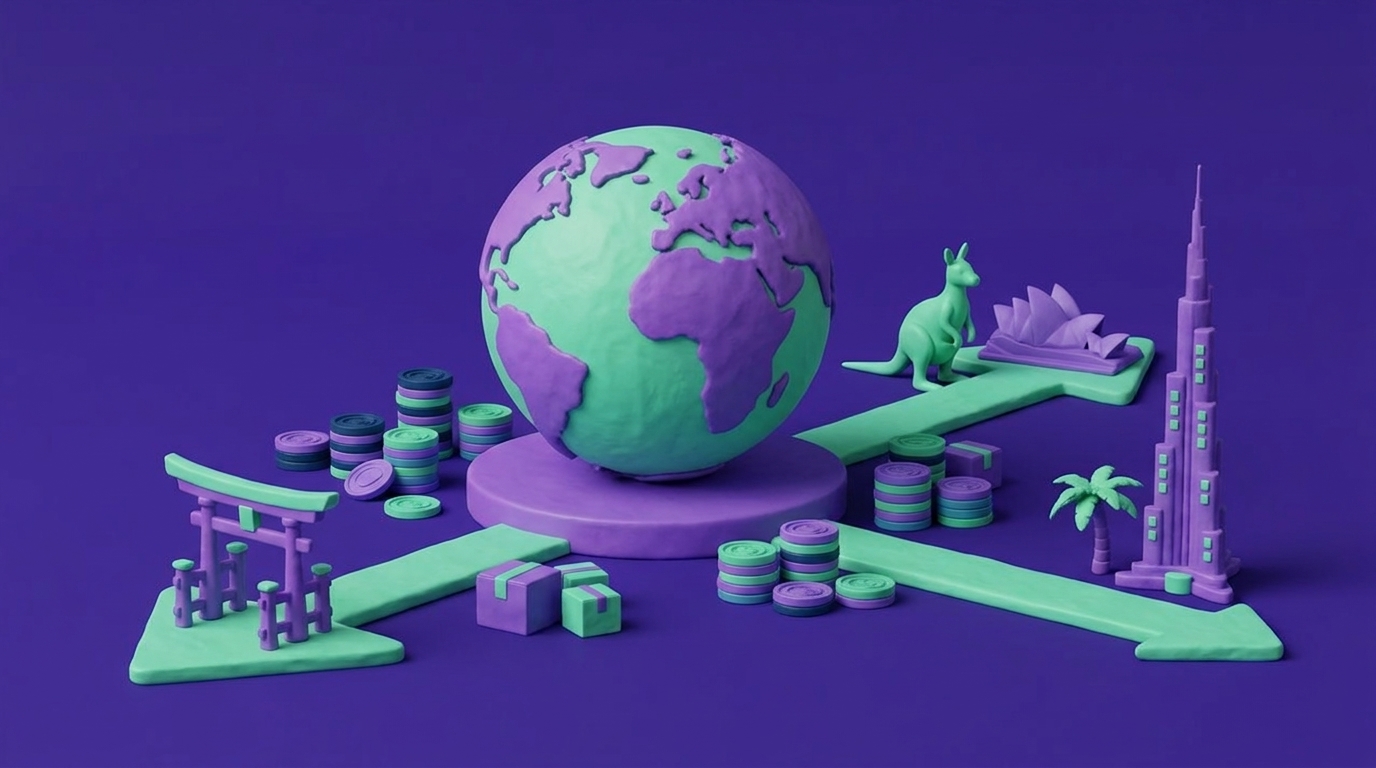

Over 60% of Amazon's global gross merchandise value now comes from marketplaces outside the US, yet the vast majority of international expansion content stops at Europe. Japan, Australia, and the UAE represent three of the fastest-growing Amazon marketplaces for US brands, and each one has distinct enrollment rules, FBA mechanics, and advertising maturity that generic guides never address. This is the operator-level playbook for expanding into all three.

Amazon Japan: The Largest Marketplace Nobody Talks About
Amazon.co.jp is the fourth-largest Amazon marketplace globally by revenue. Japan's e-commerce market exceeded $200 billion in 2025 according to Statista estimates, and Amazon holds a dominant share of product search. For US sellers, the opportunity is real: Brand Analytics data shows that health supplements, beauty, pet supplies, and home organization consistently rank among the top-growing subcategories on Amazon Japan.
Enrollment and Importer of Record
You do not need a Japanese entity to open a Seller Central account. Amazon's Global Selling program lets you register with your US business details. The friction point is the Importer of Record (IOR) obligation. Japanese customs requires a resident importer on every shipment. Your IOR handles customs declarations, pays consumption tax (10%) at the border, and ensures your products meet Japan's Pharmaceutical and Medical Device Act (PMDA) or Food Sanitation Act requirements where applicable. Failing to appoint one means your inventory sits at the port.
Several third-party IOR providers operate in Japan: companies like Brokerage Japan and Nippon Express offer IOR-as-a-service. Budget JPY 30,000-80,000 per month for basic IOR services depending on shipment volume. If you sell ingestibles or topical products, expect a longer compliance review before your first shipment clears.
FBA in Japan
Amazon operates multiple fulfillment centers across Honshu. FBA fees are comparable to US rates on a per-unit basis, though inventory placement fees apply if you ship to a single FC and Amazon distributes internally. Removal and disposal fees run around JPY 30-50 per standard-size unit. One operational note: Japan's FBA storage limits are generous compared to the US, and long-term storage fees kick in at 365 days rather than the rolling system stateside.
Advertising and Revenue Expectations
Japan has the most mature ad platform of the three marketplaces covered here. Sponsored Products, Sponsored Brands (including video), Sponsored Display, and Amazon DSP are all available. CPCs tend to run 30-50% lower than US equivalents in comparable categories. If you are already running a disciplined PPC optimization strategy on Amazon US, you can port campaign structures directly and adjust bids downward.
Realistic year-one revenue for a mid-market US brand entering a competitive subcategory (supplements, skincare): $15,000-$40,000/month within 6-9 months of consistent ad spend and listing optimization. Categories with less local competition, like niche pet accessories, can break even faster.
Australia: Low Complexity, Modest Scale
Amazon.com.au launched in late 2017 and has grown steadily but remains a smaller marketplace. Australia's total addressable e-commerce market is roughly $50 billion, and Amazon's share is growing but still trails local incumbents. The advantage: competition per ASIN is significantly lower than any other English-language Amazon marketplace.
GST Registration for Non-Resident Sellers
If your Australian sales exceed AUD 75,000 annually, you must register for Goods and Services Tax (GST) with the Australian Taxation Office. Amazon collects GST on low-value imported goods (under AUD 1,000) at checkout, but FBA sellers storing inventory in Australian fulfillment centers are making domestic supplies, and that triggers a separate GST obligation regardless of threshold. Register proactively. The process is straightforward for non-residents and can be completed online with an Australian Business Number (ABN) application.
No local entity is required. You register as a non-resident importer and can use your US business details.
FBA, Advertising, and What to Expect
Amazon operates a single primary FC region in Australia (Melbourne). Inventory placement is simpler because there is less distribution complexity, but removal costs per unit are higher on a relative basis due to fewer disposal options. Plan on AUD 0.50-1.00 per unit for removals.
The advertising suite is more limited than Japan. Sponsored Products and Sponsored Brands are fully available. Sponsored Display rolled out in recent years, and DSP access exists but requires higher minimum spend commitments and is typically managed through Amazon's managed-service team or an agency with DSP seats. CPCs are among the lowest on any Amazon marketplace: AUD 0.20-0.60 in most categories.
Revenue expectations should be calibrated accordingly. A strong US brand in home, kitchen, or beauty can realistically generate AUD 5,000-15,000/month within the first year. The upside is margin: lower ad costs and less price competition mean contribution margins often exceed what you see on Amazon US. If your target ACOS on US is 25%, expect to operate at 15-18% in Australia with proper campaign structure.
The UAE: Arabic Content, Compliance, and a Wealthy Customer Base
Amazon.ae (formerly Souq.com) serves the UAE and broader Middle East. GDP per capita in the UAE ranks among the highest globally, and Amazon shoppers in the region index heavily toward premium brands, supplements, electronics accessories, and personal care. The marketplace is small by absolute volume but growing at double-digit rates year over year.
Entity Requirements and Product Compliance
You can register on Amazon.ae with a US entity. No local trade license is needed for FBA sellers shipping into Amazon's UAE fulfillment centers. Where things get specific: the UAE requires product compliance documentation for many categories. Cosmetics and skincare need Emirates Authority for Standardization and Metrology (ESMA) registration or equivalent documentation. Food products require municipality-level import permits. Electronics must carry UAE-specific safety certifications.
The Arabic content mandate is non-negotiable. Listings must include Arabic translations of titles, bullet points, and product descriptions. A+ Content should also be localized. Machine translation is a fast way to get rejected by customers. Invest in human translators who understand Gulf Arabic (not Levantine or Egyptian dialect). A strong A+ content strategy with proper Arabic localization can double conversion rates compared to English-only listings in the same category.
FBA and Advertising in the UAE
Amazon operates FBA out of fulfillment centers in Dubai and Abu Dhabi. Inventory placement fees are minimal because the country is geographically compact. Removal fees run approximately AED 2-4 per unit. One watch-out: summer heat in the UAE means temperature-sensitive products (chocolate, certain supplements) require additional packaging considerations.
Sponsored Products and Sponsored Brands are available. Sponsored Display has limited rollout. DSP is accessible through managed service with minimum budgets typically starting around $10,000/month. CPCs range from AED 0.50-2.00 depending on category, with beauty and supplements at the higher end. The ad auction is less competitive than the US, but conversion rates can be volatile because the customer base is smaller and heavily influenced by seasonal shopping patterns (Ramadan, White Friday).
Year-one revenue for a well-positioned US brand: $8,000-$25,000/month depending on category. Premium-positioned products with strong brand stories tend to outperform value brands in this market.
Currency Conversion and Repatriation: ACCS vs. Third-Party Providers
Amazon's Currency Converter for Sellers (ACCS) is the default option across all three marketplaces. It works. It is also expensive: expect a 1-1.5% conversion spread on every disbursement. For a brand doing $30,000/month across Japan and the UAE, that is $3,600-$5,400 per year lost to conversion fees alone.
Alternatives like Payoneer and WorldFirst offer tighter spreads (0.3-0.8%) and local receiving accounts in JPY, AUD, and AED. Both integrate with Amazon Seller Central. Setup takes 1-2 weeks. For any brand expecting more than $10,000/month in combined international revenue, switching to a third-party provider pays for itself immediately.
Which Marketplace Should You Prioritize?
Use this framework based on three variables: category fit, margin structure, and operational complexity.
- High-margin consumables (supplements, beauty, personal care): Start with Japan. Largest addressable market, mature ad platform, and strong demand for US brands. The IOR requirement adds complexity but is manageable with a competent logistics partner.
- Home, kitchen, and lifestyle products: Australia offers the fastest path to profitability. Lower competition, English-language listings, and simple GST registration make it the lowest-friction option. Revenue ceiling is lower, but margins are attractive.
- Premium or luxury-positioned brands: The UAE customer base skews toward higher AOVs. If your average selling price is above $30 and your brand story resonates with an affluent, brand-conscious audience, Amazon.ae can deliver strong unit economics despite the Arabic localization investment.
If you have already completed an Amazon Europe expansion, Japan is the natural next step because many of the operational muscles (international logistics, multi-currency accounting, localized content) are already developed. If Europe feels too complex as a first move, Australia is the gentlest on-ramp to international selling.
Pre-Launch Checklist by Marketplace
Japan
- IOR appointment: Contract with a licensed Importer of Record before shipping inventory
- Product compliance: Confirm PMDA, Food Sanitation Act, or PSE electrical safety requirements for your category
- Listing localization: Professional Japanese translation of titles, bullets, descriptions, and A+ Content
- Consumption tax: Register for JCT if expected revenue exceeds JPY 10 million annually
- Currency setup: Open a JPY receiving account with Payoneer or WorldFirst
Australia
- ABN and GST: Apply for an Australian Business Number and register for GST with the ATO
- Product standards: Check ACCC product safety standards for your category, especially for children's products and electronics
- Listings: Adapt US English to Australian English spelling conventions (colour, organisation, etc.)
- Shipping plan: Coordinate sea freight to Melbourne FC; air freight for initial test inventory
UAE
- ESMA compliance: Register products requiring Emirates Standardization certification
- Arabic content: Commission human translation of all listing content in Gulf Arabic
- Labeling: Confirm Arabic labeling requirements for physical packaging where applicable
- Heat sensitivity: Assess whether products require climate-controlled shipping or packaging during summer months
- Ramadan planning: Build an annual marketing calendar that accounts for peak shopping periods unique to the region
Customer service language requirements vary: Japan requires Japanese-language support (Amazon handles most FBA customer service, but Seller-Fulfilled returns and A-to-Z claims need Japanese responses). Australia operates in English. The UAE requires Arabic support capability for buyer messages.
Japan, Australia, and the UAE are where the next wave of international Amazon revenue will come from for US brands that move now. Hyperzon helps DTC brands launch into new Amazon marketplaces with localized listings, compliant operations, and ad strategies built for each region's maturity level. Get a free Amazon audit.
Article was originally published on 30 October, 2026
Frequently Asked Questions
-
Do I need a local entity to sell on Amazon Japan?
No. You can register as a non-resident seller, but you must appoint an Importer of Record (IOR) in Japan to handle customs clearance, duties, and product compliance documentation. -
Is GST registration required for Amazon Australia if I sell from the US?
Yes. Non-resident sellers exceeding AUD 75,000 in annual Australian sales must register for GST. Amazon collects GST on low-value imported goods under AUD 1,000, but registration is still required for FBA sellers. -
What language must my Amazon UAE listings be in?
Amazon.ae requires dual-language listings. Product titles and bullet points must appear in both English and Arabic. A+ Content should also be localized into Arabic for better conversion rates. -
Which of the three marketplaces has the most mature advertising options?
Amazon Japan has the most mature ad platform, offering Sponsored Products, Sponsored Brands, Sponsored Display, and DSP. Australia and UAE have Sponsored Products and Sponsored Brands but more limited DSP access. -
How does Amazon ACCS compare to Payoneer for international currency conversion?
Amazon Currency Converter for Sellers (ACCS) is the simplest option but typically charges a 1-1.5% conversion spread. Payoneer and WorldFirst offer tighter spreads, usually 0.3-0.8%, and faster repatriation to US bank accounts.